
-
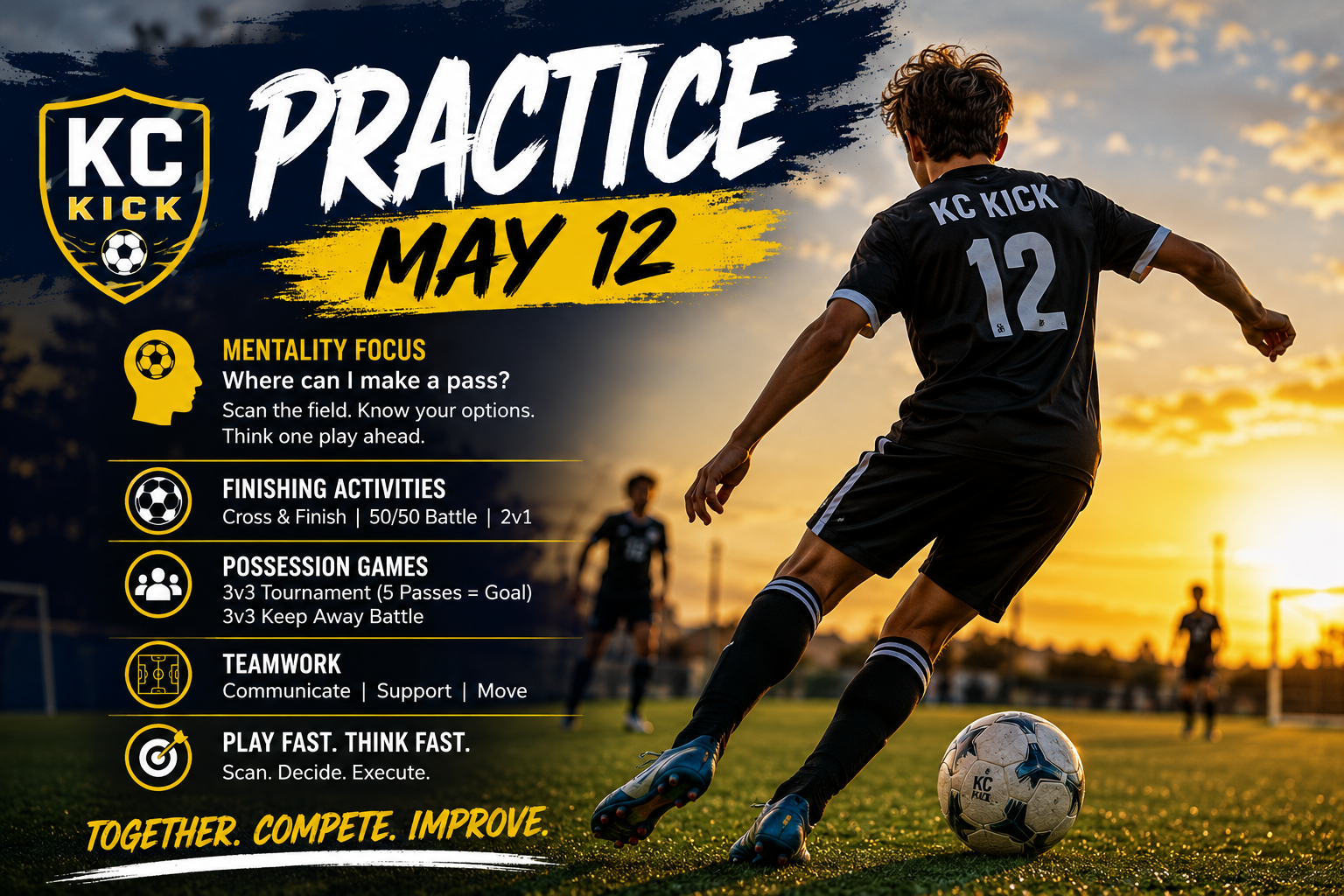
⚽ KC Kick Practice Plan – Tuesday, May 12
Focus of the Day
Finishing, possession, and thinking ahead before receiving the ball.
Mental Note 🧠
“Where can I make a pass?”
Before the ball arrives:
- Scan the field
- Know your options
- Think one play ahead
Great players already know where they want to pass before they receive the ball.
Encourage lots of shoulder checks and communication throughout practice.
⏰ Practice Schedule (5:15-6:45 PM)
5:15–5:20 Starting Activity
Ball Mastery + Juggling
Focus move:
Matthews
Players work on:
- Slow technique first
- Explosive exit touch
- Both feet
Then transition into juggling:
- Bounce juggling
- Feet only
- Partner juggling challenges
- Weak foot touches
Encourage players to keep eyes up often during touches.
🔥 Warm Up Game
Keep Away Rounds
Three quick rounds of possession games.
⚽ Finishing Activity #1
Cross & Finish
Large goal setup with no defenders.
Players work on:
- Timing runs
- Attacking the ball
- One touch finishes
- First time shots
Rotate crossing sides often.
Coaching points:
- Arrive under control
- Attack space aggressively
- Keep shots low and balanced
💪 Finishing Activity #2
50/50 Ball Battle to Goal
Coach plays a loose ball between attacker and defender.
Attacker objective:
- Meet defender strong
- Use arm legally for separation
- Get into space
- Finish quickly
Coaching points:
- Strong first contact
- Explode after winning ball
- Protect the ball
- Quick shot mentality
⚔️ Finishing Activity #3
2v1 To Goal
Two attackers vs one defender.
This will also be the pregame activity.
Focus:
- Quick decisions
- Passing before pressure arrives
- Creating angles
- Finishing under pressure
Encourage attackers to recognize:
“Where is my next pass?”
🧱 Small Goal Tournament
3v3 Tournament
Small goals setup.
Rule:
5 passes = 1 goal
Players must:
- Move constantly
- Support teammates
- Keep possession under pressure
Encourage communication and scanning before receiving.
🔄 Possession Battle
3v3 Keep Away Game
No goals. Pure possession battle.
Focus:
- Patience
- Passing angles
- Body positioning
- Movement off the ball
Challenge players to keep long passing sequences.
🏁 Final Scrimmage
Scrimmage – No Goalies
Normal scrimmage without goalkeepers.
Encourage:
- Fast ball movement
- Quick finishes
- Constant movement
- Early decision making
Coaching reminders:
- Scan before receiving
- Move after every pass
- Think ahead
🧊 Team Huddle
Ask:
- Did you know your next pass before getting the ball?
- Who did a good job scanning today?
- How did moving after passing help your team?
Finish with:
“The game gets easier when you think before the ball arrives.”
-
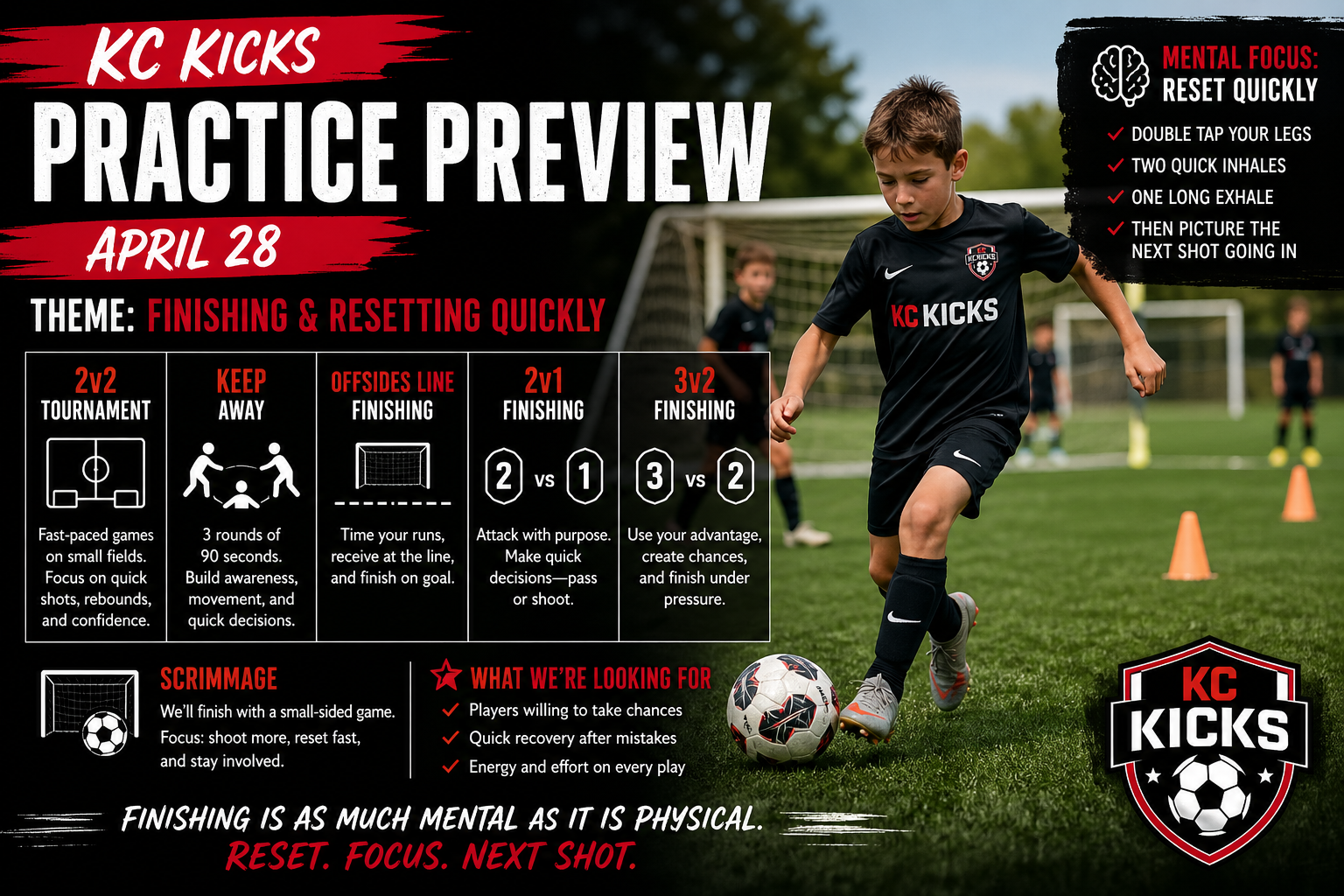
⚽ KC Kicks Practice Preview – April 28
Theme: Finishing & Resetting Quickly
Tonight we’re focusing on one of the most important parts of the game, finishing.
Not just how to score, but how to handle the moments when we don’t.
🧠 Practice Message: Reset Quickly
Every player misses shots. That’s part of the game.
What matters is what happens next.
Tonight we’ll introduce a simple reset:
- Double tap your legs
- Two quick inhales
- One long exhale
- Then picture the next shot going in
We want players ready for the next opportunity, not stuck on the last one.
⚽ What We’ll Be Working On
🔄 Possession (Keep Away)
Short, high-energy rounds to build:
- Awareness
- Movement
- Quick decisions
After Possession battle setup 3 min matches 2v2.
Focus:
- Quick shots
- Going after rebounds
- Confidence in front of goal
🥅 Finishing Drills (Main Focus)
Offsides Line Finishing
- Timing runs
- Receiving and shooting in stride
Setup 4 lines outside of goal box. Inside players make pass to outside players without being offsides. Once player receives pass they can shoot on goal.
2v1 Finishing
- Making quick decisions
- Knowing when to pass vs shoot
Players will form into 3 lines in a triangle outside the goal box. Players will make runs and passes to get an open shot.
3v2 Finishing
- Using the advantage
- Finishing under pressure
⚽ Scrimmage
We’ll finish with a game where the focus is simple:
- Shoot more
- Reset fast
- Stay involved
-
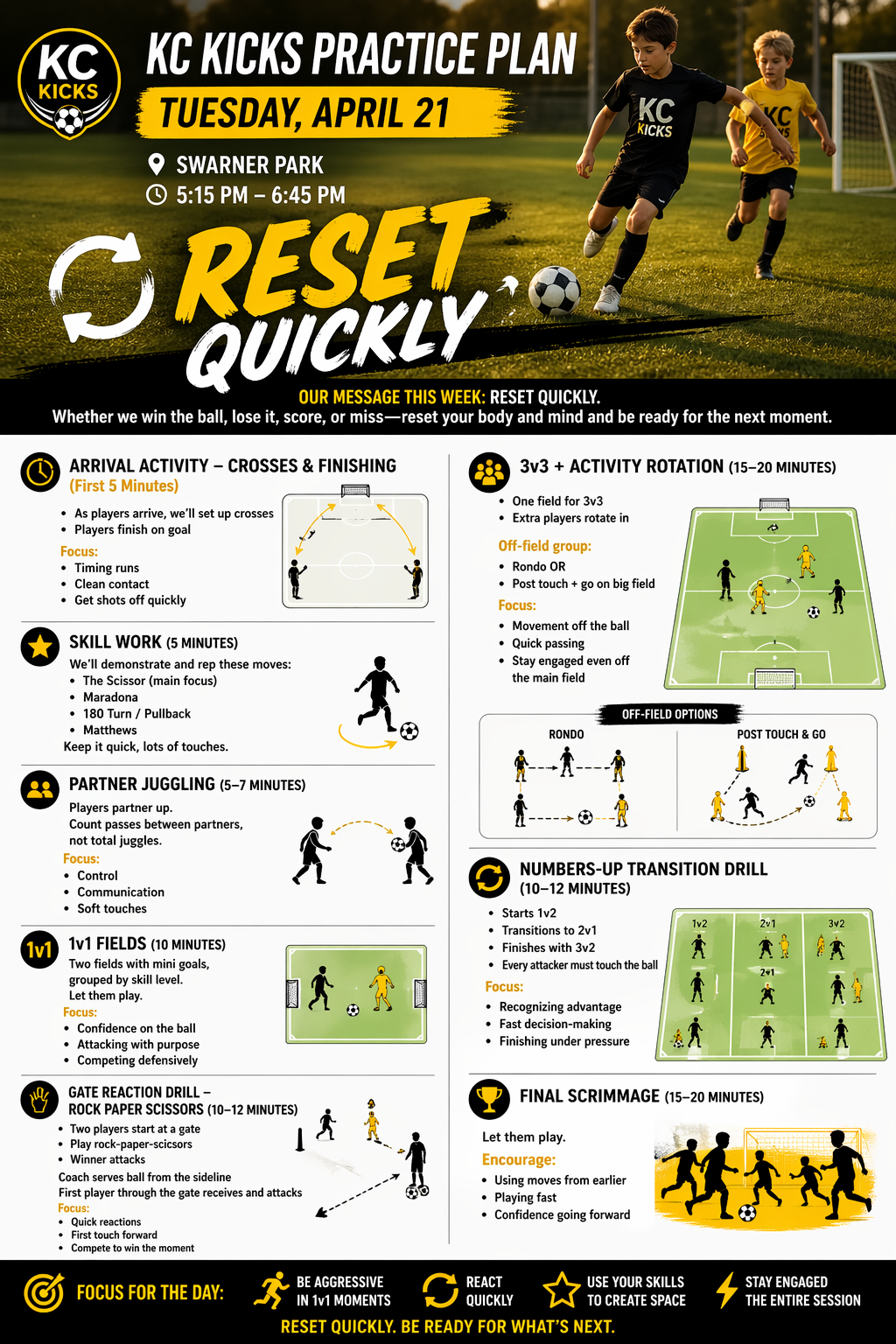
KC Kicks Practice Plan – Tuesday April 21
Swarner Park
5:15 PM – 6:45 PMThis session will keep things moving. We’ll mix skill work with competitive moments and build toward game situations.
Arrival Activity – Crossing & Finishing (First 5 minutes)
As players arrive, we’ll jump right into action.
- Set up crosses
- Players finish on goal
Focus:
- Timing runs
- Clean contact
- Getting shots off quickly
Skill Work (5 minutes)
We’ll demonstrate and rep a few moves:
- Scissor (main focus)
- Maradona
- 180 turn / pullback
- Matthews
Keep it quick, lots of touches.
Partner Juggling (5–7 minutes)
Players partner up.
- Count passes between partners, not total juggles
Focus:
- Control
- Communication
- Soft touches
1v1 Fields (10 minutes)
Two fields with mini goals, grouped by skill level.
Let them play.
Focus:
- Confidence on the ball
- Attacking with purpose
- Competing defensively
Gate Reaction Drill – Rock Paper Scissors (10–12 minutes)
Setup:
- Two players start at a gate
- Play rock-paper-scissors
- Winner attacks
Action:
- Coach serves ball from the sideline
- First player through the gate receives and attacks
Focus:
- Quick reactions
- First touch forward
- Competing to win the moment
3v3 + Activity Rotation (15–20 minutes)
Setup:
- One small field for 3v3
- Extra players rotate in
Off-field group:
- Rondo or
- Post touch + go on big field
Focus:
- Movement off the ball
- Quick passing
- Staying engaged even off the main field
Large Field 2 small goals 1 big goal
2 Strikers 2 wingers shooting drill
Teams take turns passing it to the winger, the winger is stationary and crosses it to the striker and the striker finishes.
3v2 Counter Attack Drill- Starts 1v2
- Transitions to 2v1
- Finishes with 3v2
Focus:
- Recognizing advantage
- Fast decision-making
- Finishing under pressure
Final Scrimmage (15–20 minutes) ⚽
Let them play.
Encourage:
- Using moves from earlier
- Playing fast
- Confidence going forward
Focus for the Day
- Be aggressive in 1v1 moments
- React quickly
- Use your skills to create space
- Stay engaged the entire session
Thanks for being here. You’re not just a ride to practice, you’re part of your kid’s development as an athlete and as a person.
This page is here to help parents understand how we approach youth soccer: teach the game, build confidence, and focus on effort over outcome. Winning is great. But it’s not the goal. Growth is.
Below, you’ll find tools, articles, and reminders that help keep things in perspective, especially on game day.
💡 1. Coaching Philosophy
Our approach is built around positive coaching, long-term development, and keeping the game fun.
✔ Teach decision-making, not just drills
✔ Value effort more than the scoreboard
✔ We don’t yell at kids and we ask that you don’t either▶️ [Read the Philosophy]
🎧 2. Supporting Your Kid
How you talk to your child before, during, and after a game matters. This section covers simple ways to encourage, not pressure.
✔ What to say in the car ride home
✔ The “5 words” every kid wants to hear
✔ Avoiding sideline coaching
📆 3. Game Day Expectations
Game day is for the kids. Here’s what we expect from parents to help keep things positive, productive, and fun for everyone.
✔ Sideline behavior
✔ Cheering vs. coaching
✔ Handling tough losses▶️ [Game Day Guidelines]
🏡 4. Family Support at Home
Our players improve most when there’s structure and support outside of practice. This section covers how we train at home — with help from the family.
✔ Daily Skill Work: Players pick 3 moves a day and repeat each 50–100 times
✔ Bounce Juggling: 250 touches a day to build coordination and rhythm
✔ Game IQ Reports: Watch a video, write a report, and present to the family
✔ Fascia Training: A short routine to reduce injury risk and build foot strength
▶️ [View the Daily Routine & Family Support Page]
We want every kid to walk away from this season better than they started, not just as a player but as a person. That takes good coaching, great teammates, and supportive parents.
Thanks for being part of the team.